
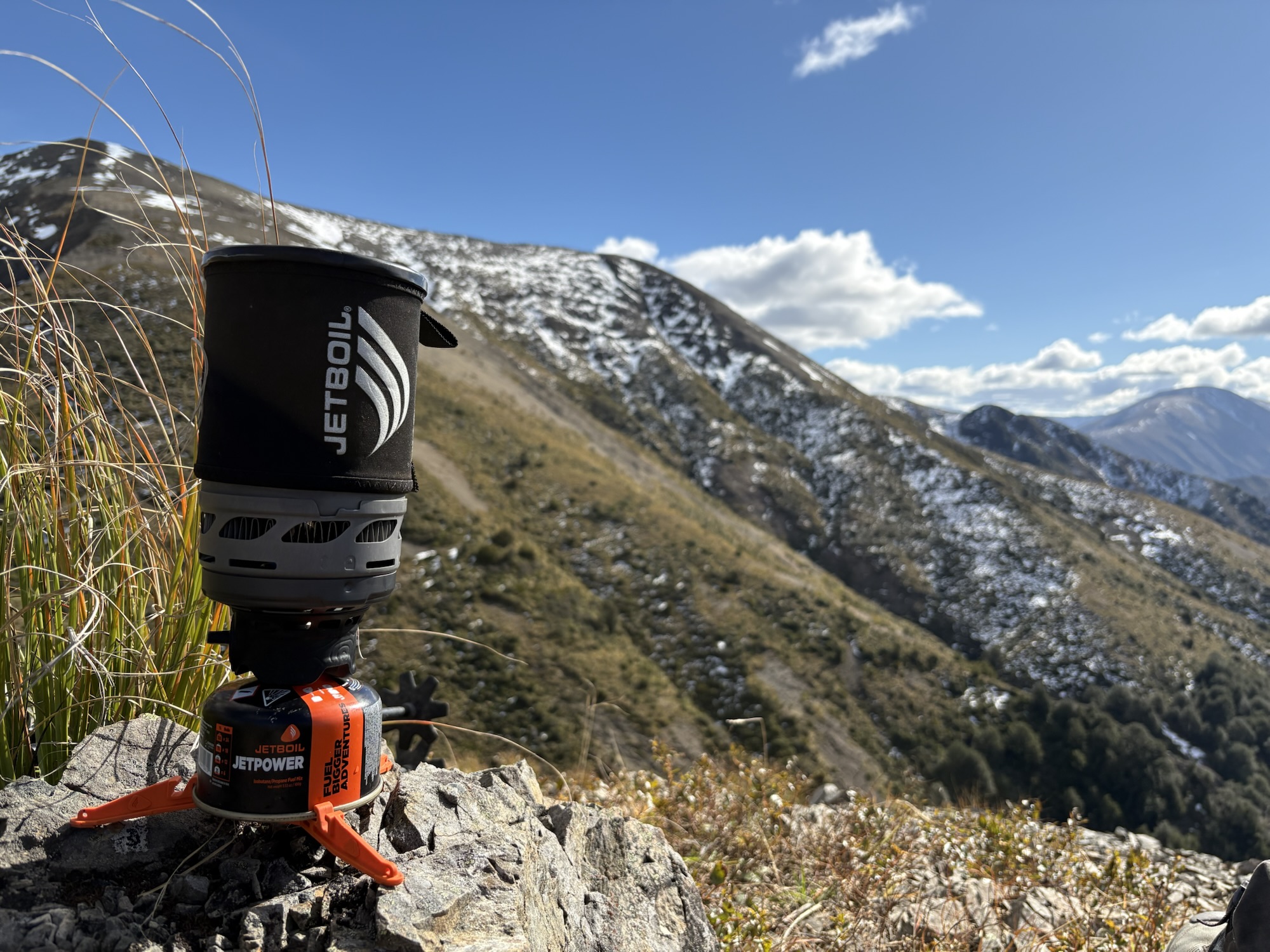
By Seth Brown – Resilient Hunter
There’s a phrase that gets thrown around a lot in hunting and hiking circles:
“If it’s not 100 calories an ounce, it doesn’t make it into my pack.”
On the surface, it makes sense. When every gram matters, calories per ounce is a useful metric. It stops you carrying food that is mostly air, water, packaging, or bulk. It forces you to think about energy density. In the mountains, that matters.
But it can also become a trap.
Because calories per ounce only tells you what is printed on the packet. It does not tell you how quickly that food will digest, how well you will tolerate it when cold and tired, whether it will keep you moving, whether it will sit in your stomach like wet concrete, or whether it provides anything beyond raw energy.
Calories per ounce gets food into the pack. Bioavailability, digestion, tolerance, water requirement, and morale decide whether it actually works in the mountains.
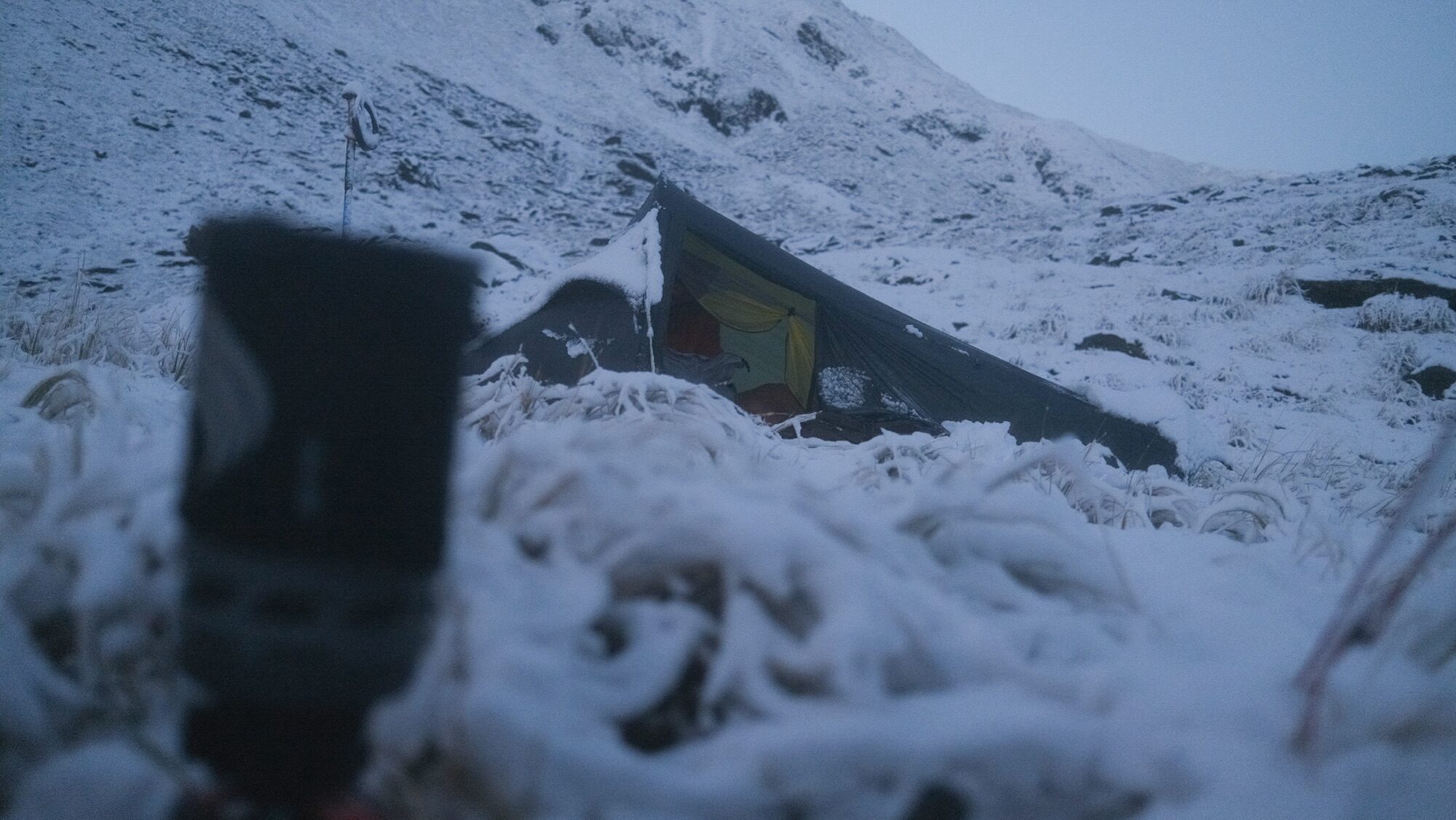
The classic example is olive oil. Olive oil is often quoted at roughly 250 to 260 calories per ounce. On paper, it is close to the perfect backcountry food. It is light for the amount of energy it contains, easy to pack, cheap, and shelf stable.
If calories per ounce were the only measure that mattered, we would all just carry a bottle of olive oil and drink it on the hill.
But almost nobody does that.
Not because olive oil is useless. It is an excellent calorie-dense food. The issue is not simply whether the body can absorb the energy. The issue is whether that energy is usable, tolerable, palatable, and appropriate for the work you are doing.
That distinction matters.
Food labels give us useful information, but they do not tell the whole story. They do not tell us whether a meal will be easy to eat after a brutal climb. They do not tell us whether it will digest well before a long sidle. They do not tell us whether it will make us feel fuelled, bloated, flat, or human again.
And in the backcountry, that matters just as much as the number on the packet.
The Five-Day Tahr Hunt That Started the Question
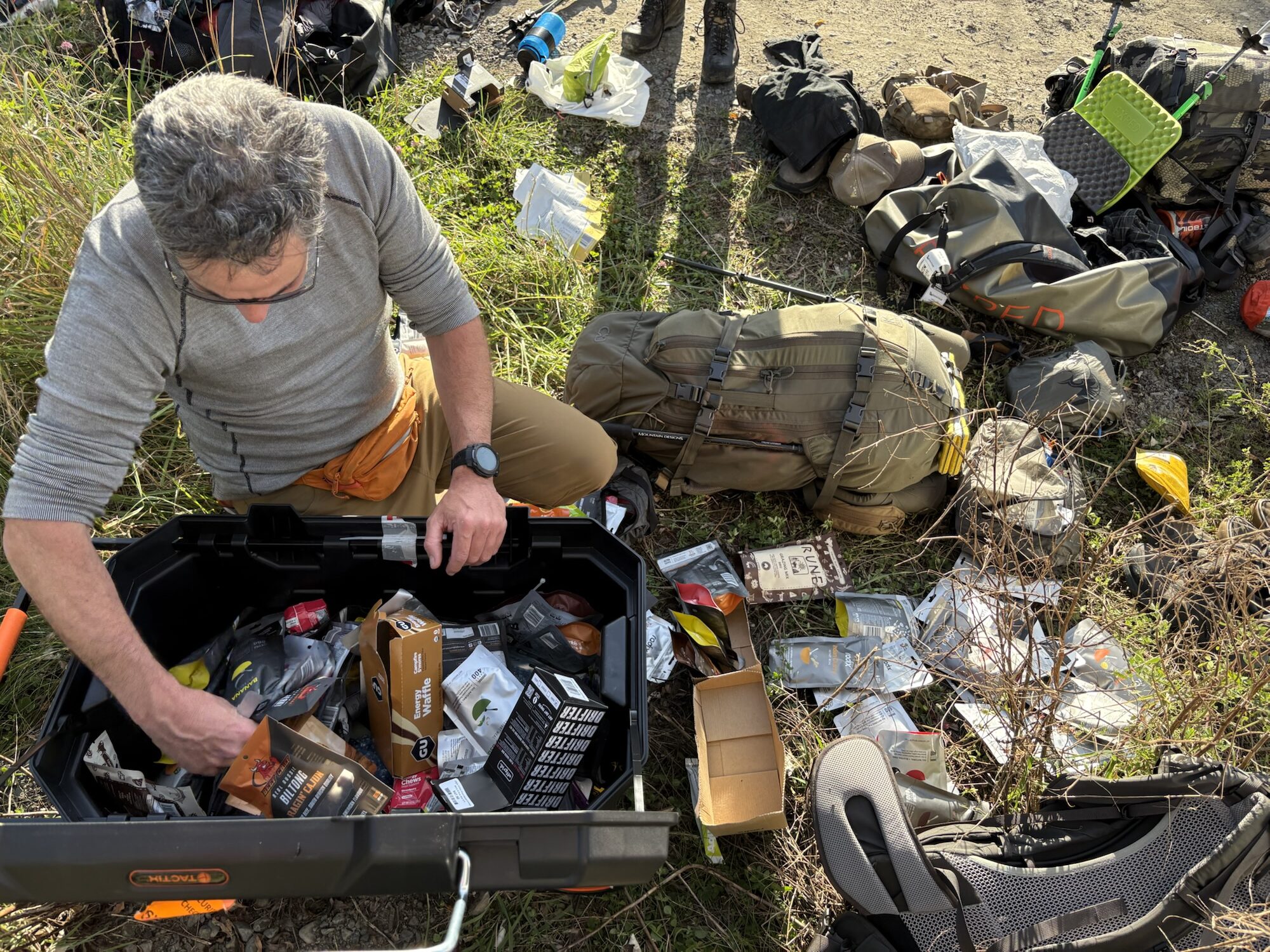
This article really started after a recent East Coast tahr hunt with a hunter from Wyoming.
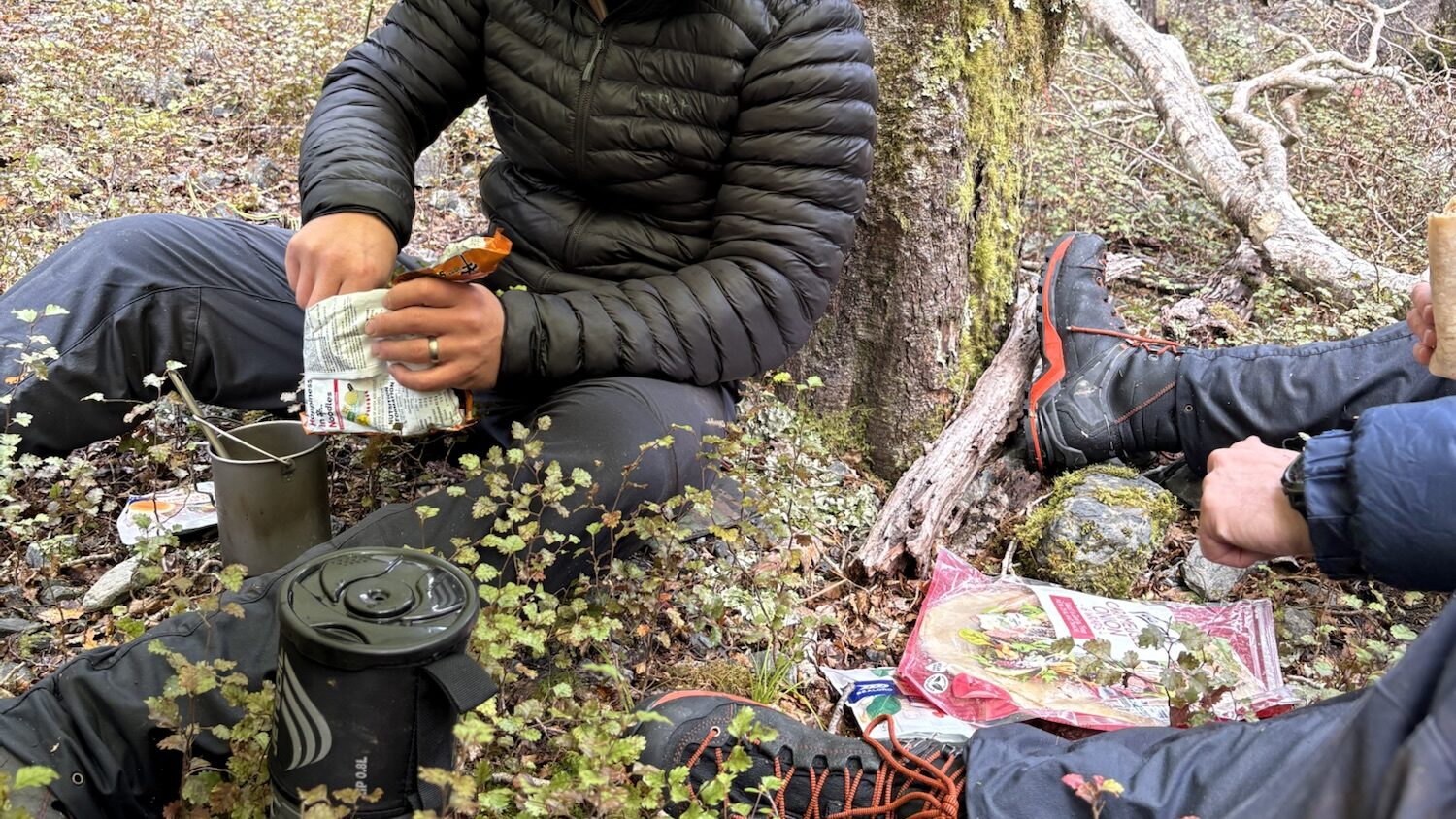
He was an experienced ultra-runner and endurance athlete, and I was genuinely surprised when he decided not to pack a stove for a five-day hunt. His food plan revolved around roughly ten pounds of raisins, dates, Nice & Natural bars, and corn chips.
No freeze-dried meals.
No hot food.
No stove.
No evening ritual of boiling water, waiting ten minutes, and eating something vaguely resembling dinner.
At first, that seemed almost reckless. But the more I thought about it, the more it raised a better question:
Are purpose-built backpacking meals actually necessary, or are they just convenient?
The answer is probably both.
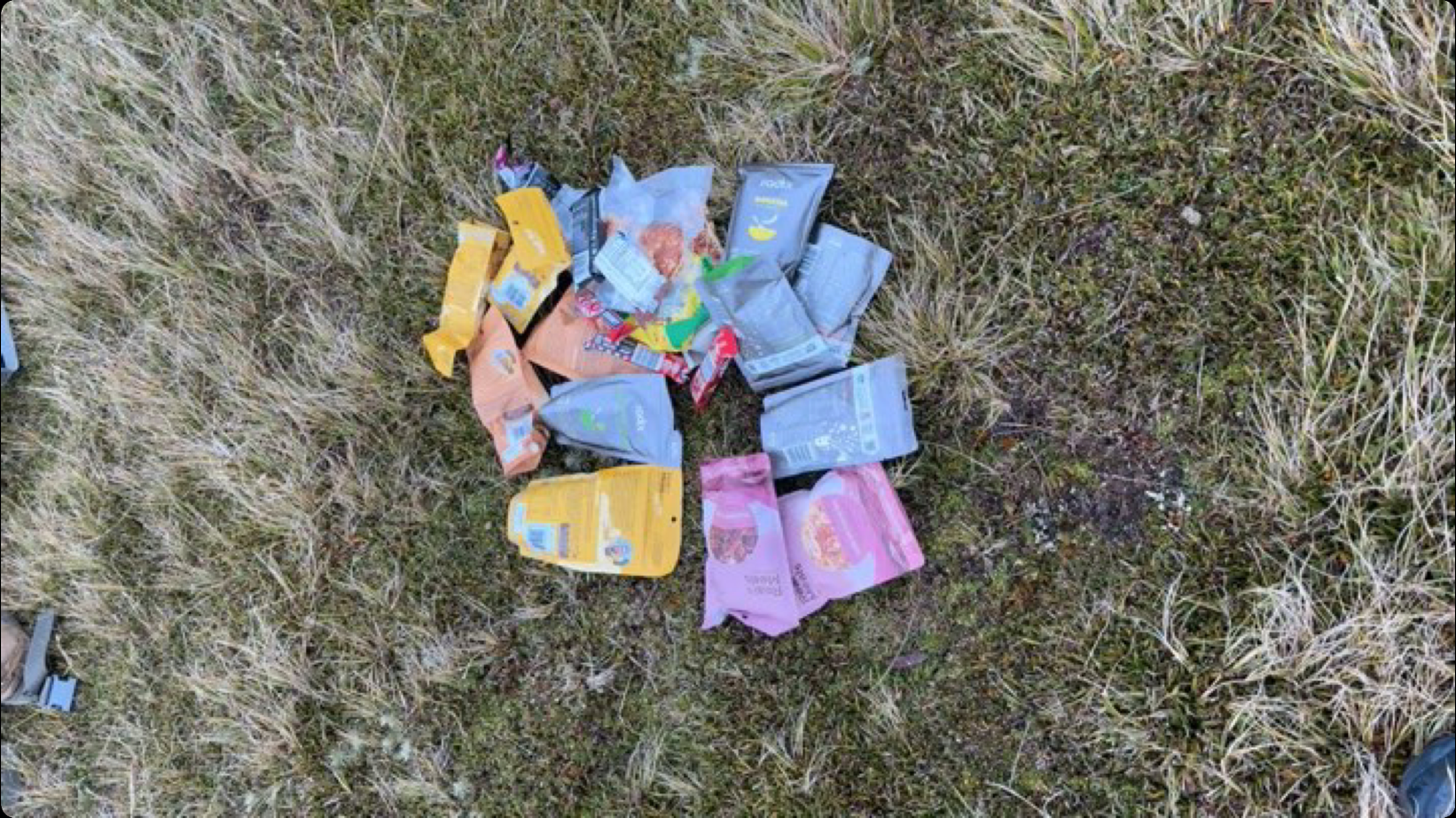
Freeze-dried meals solve a lot of problems. They are light, shelf-stable, easy to portion, easy to pack, and they provide the psychological benefit of a hot meal at the end of a long day. That last point is not trivial. In cold weather, morale matters.
But they are not magic.
A packet with “800 calories” written on the front does not automatically make it more useful than supermarket food, trail mix, jerky, cheese, salami, chocolate, corn chips, or biscuits.
The Wyoming approach was probably very high in carbohydrate, easy to eat while moving, and required no fuel, no stove, no cooking time, and no water for rehydration. That has real merit. The trade-off is monotony, lower protein quality unless deliberately managed, potentially limited savoury variety, and no hot meal when conditions get grim.
That is the real comparison.
Not freeze-dried versus supermarket food.
But convenience, tolerance, morale, water, protein, salt, calorie density, and how well the food actually fits the hunt.
Calories Per Ounce Is Useful — But It Is Not Enough
The “100 calories per ounce” rule is not stupid. It is actually a good starting point.
For reference, one ounce is about 28.35 grams. So a food that provides 100 calories per ounce gives around 350 calories per 100 grams.
That is a useful line in the sand.
Low-calorie foods are often bulky. They take up space, add weight, and do not give much back. This is why fresh fruit, vegetables, and wet foods are usually poor choices for extended trips, even though they may be excellent foods in normal life.
But there is a problem with using calorie density as the only filter. It pushes us toward foods that are extremely fatty, sugary, dry, or processed. Sometimes that is useful. Sometimes it is not.
A food can be calorie-dense and still be a poor choice for a specific job.
A bottle of olive oil is calorie-dense. That does not mean it is a good breakfast before a climb.
A packet of lollies may be easy carbohydrate. That does not mean it is dinner.
A freeze-dried meal may have 800 calories. That does not mean it will sit well in your stomach, provide enough protein, or keep you satisfied through the night.
A supermarket biscuit may look like junk food. But if it is calorie-dense, palatable, easy to eat, and gives you a psychological lift when you are cold and tired, it may have more practical value than we want to admit.
That is where the calorie trap sits.
Not in counting calories.
But in pretending that calories are the whole answer.
Two Freeze-Dried Meals: Similar Calories, Different Food
Two staple freeze-dried options available in New Zealand show the issue well.
The first is Back Country Cuisine’s Roast Chicken. The regular serve weighs 175 grams dry, requires 500 ml of boiling water, and provides:
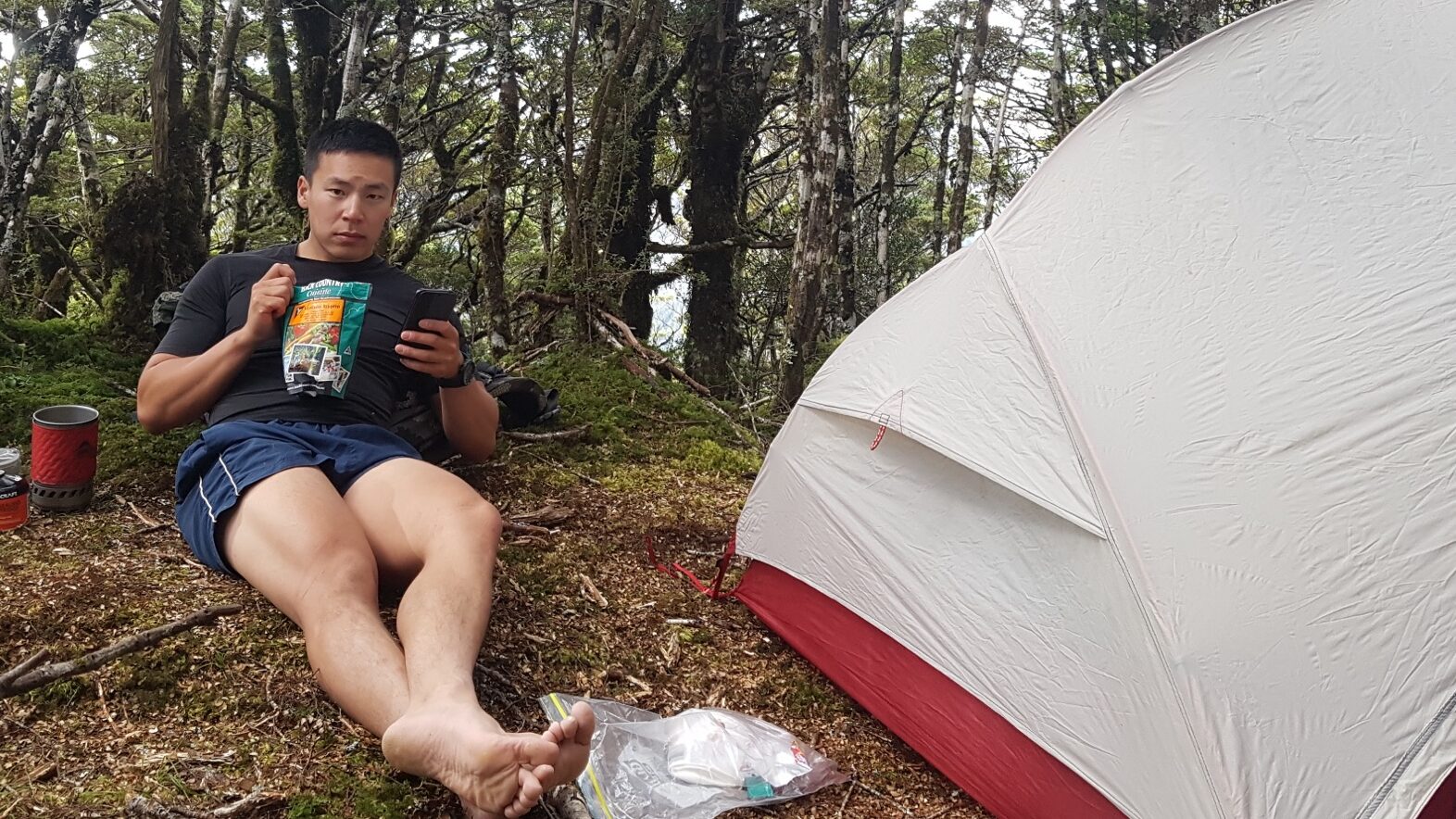
- 761 calories
- 38.5 grams protein
- 25.2 grams fat
- 88.8 grams carbohydrate
- 2410 mg sodium
The second is Radix Ultra V9 Smokey BBQ from the 800 calorie range. It weighs 159 grams dry, requires 250 ml of water, and provides approximately:
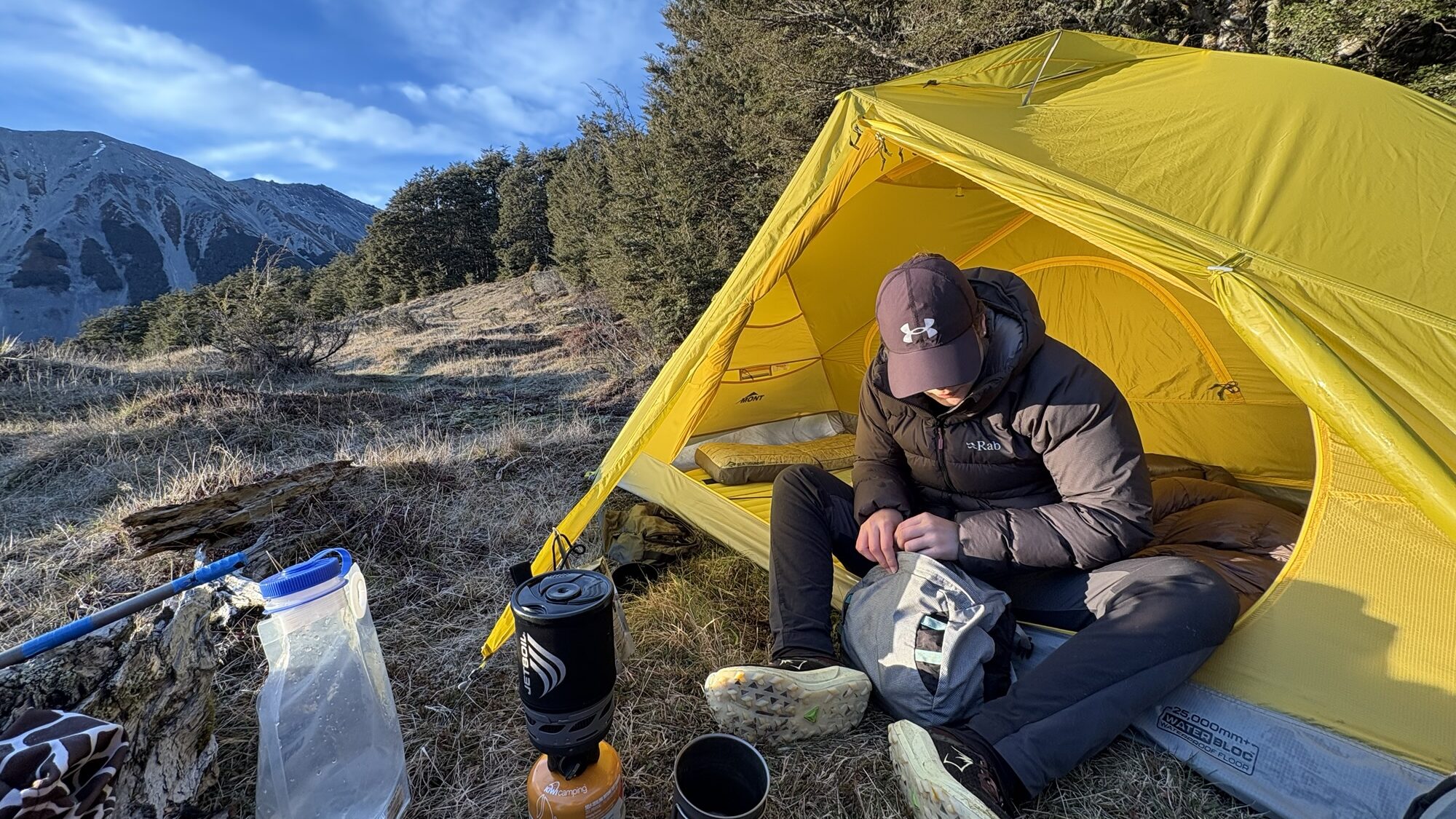
- 800 to 805 calories
- 31.3 grams protein
- around 50 grams fat
- 51.7 grams carbohydrate
- 13 grams fibre
- 7.4 grams sugars
On dry weight alone, both are efficient.
Back Country Cuisine Roast Chicken provides about 123 calories per ounce.
Radix Smokey BBQ provides about 143 calories per ounce.
Both clear the 100 calories per ounce threshold. The Radix does it more comfortably.
But the more interesting comparison is not just calories per ounce. It is what those calories are made of.
Back Country Cuisine Roast Chicken: Hot, Salty, Familiar, and Carbohydrate-Heavy
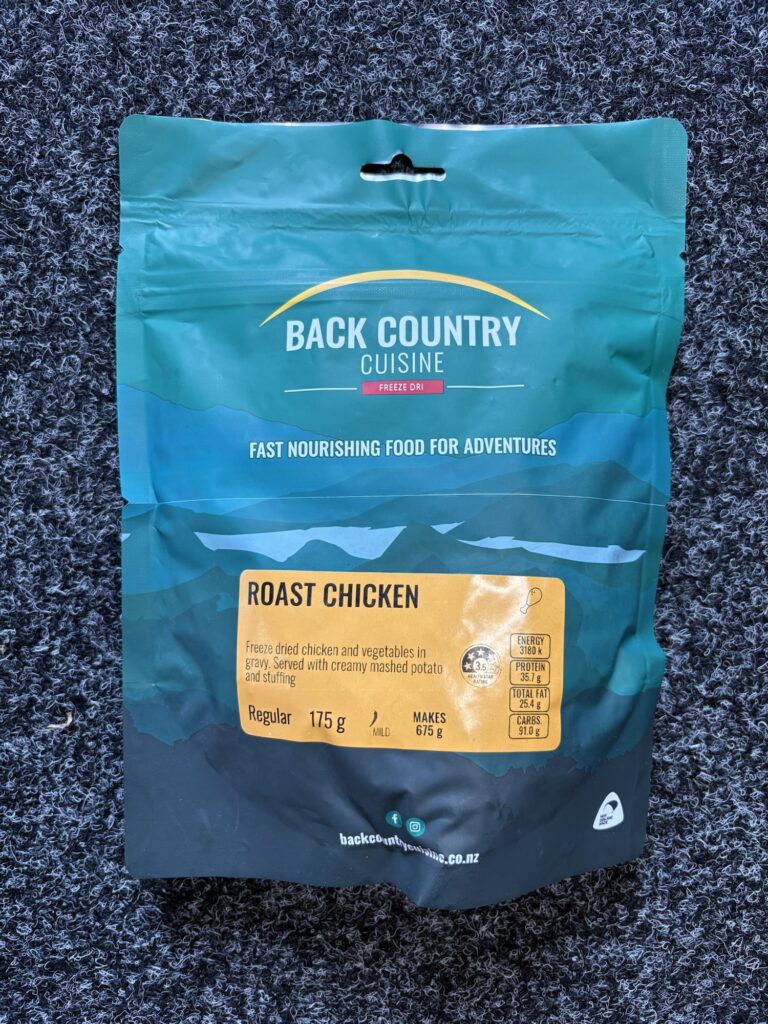
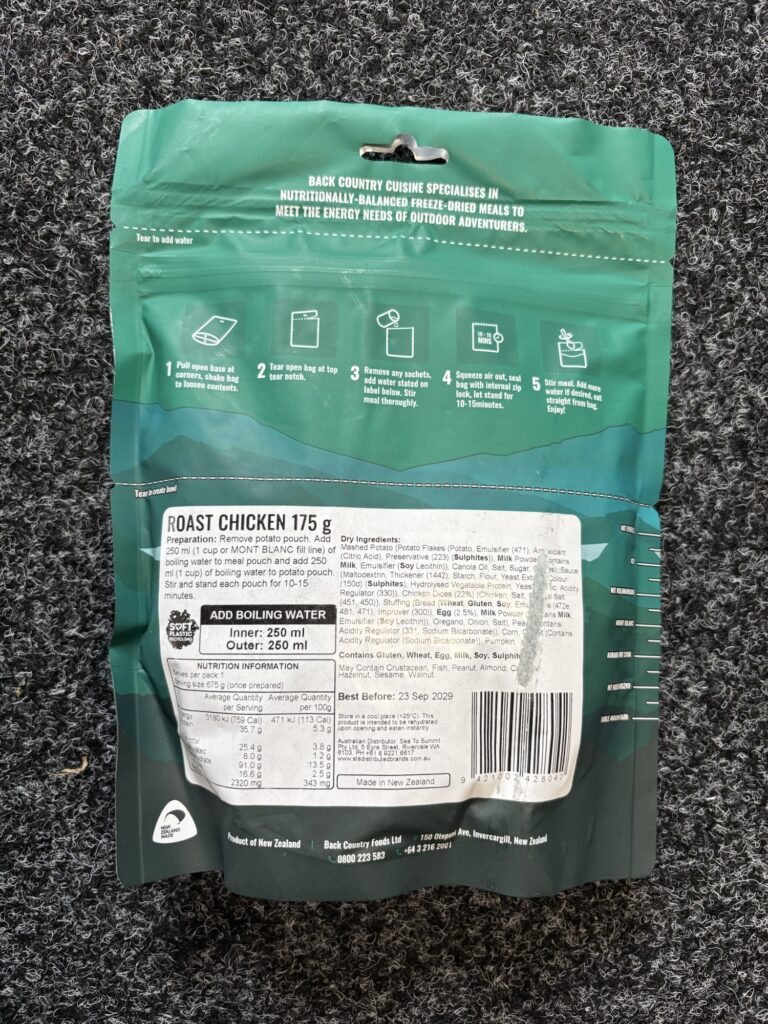
The Back Country Cuisine Roast Chicken meal is built around mashed potato, maltodextrin, starch, rice flour, chicken, stuffing, peas, corn, carrots, pumpkin, milk powder, canola oil, salt, and flavouring components.
From a backcountry energy perspective, that is not necessarily a bad thing.
Potato flakes, maltodextrin, starches, and rice flour are easy carbohydrate sources. That can be useful when you are depleted, cold, and need to replace energy after a hard day. A meal with nearly 89 grams of carbohydrate has a real role after heavy movement.
The chicken, milk powder, and egg components add protein. At 38.5 grams of protein, the meal is actually strong by freeze-dried standards. The fat content, at 25.2 grams, gives it some energy density without making it overwhelmingly rich.
The sodium is high at 2410 mg, but in the context of hard uphill movement, sweating, and cold-weather hunting, that is not automatically a negative. On some trips, salt is exactly what you want.
The weakness is that much of the meal appears to be built around processed carbohydrate, starches, thickeners, and flavour systems. That does not make it junk. It just means it is probably closer to a practical hot refuel than a nutrient-dense wholefood meal.
That may actually be its strength.
It is hot.
It is salty.
It is familiar.
It is carbohydrate-heavy.
It is likely easy to digest for most people.
After a hard day, that has value.
But I would not pretend it is the same nutritional proposition as a meal built around seeds, grains, oils, legumes, vegetables, and a broader micronutrient profile.
Radix Smokey BBQ: Denser, Fattier, and More Complete
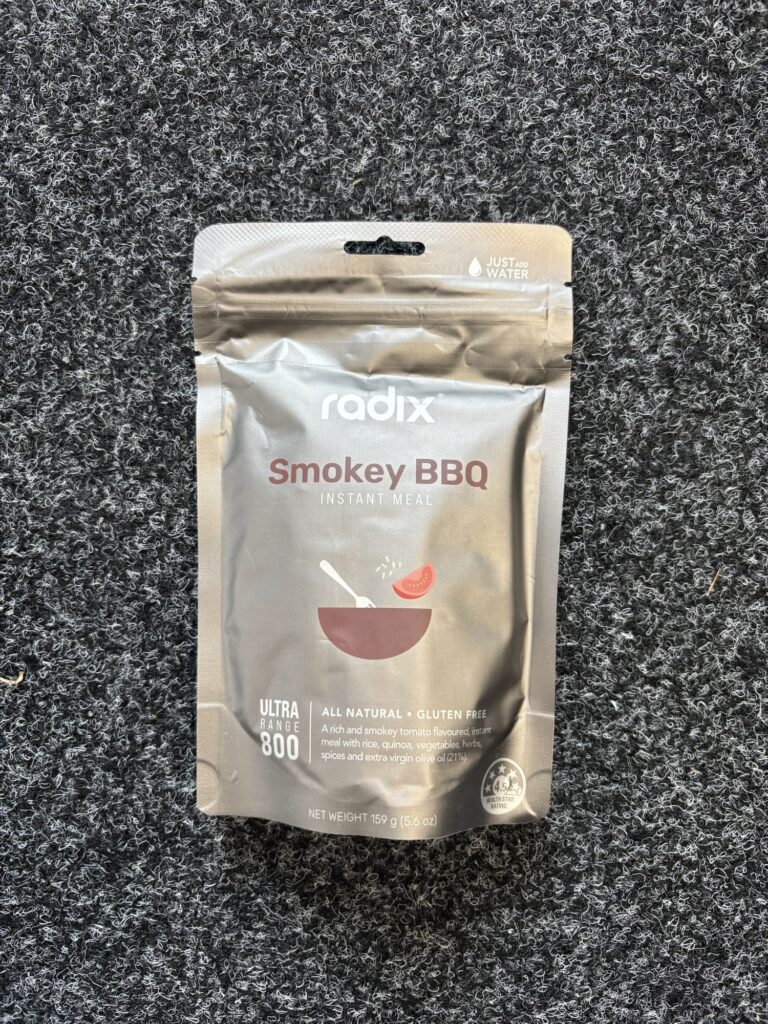
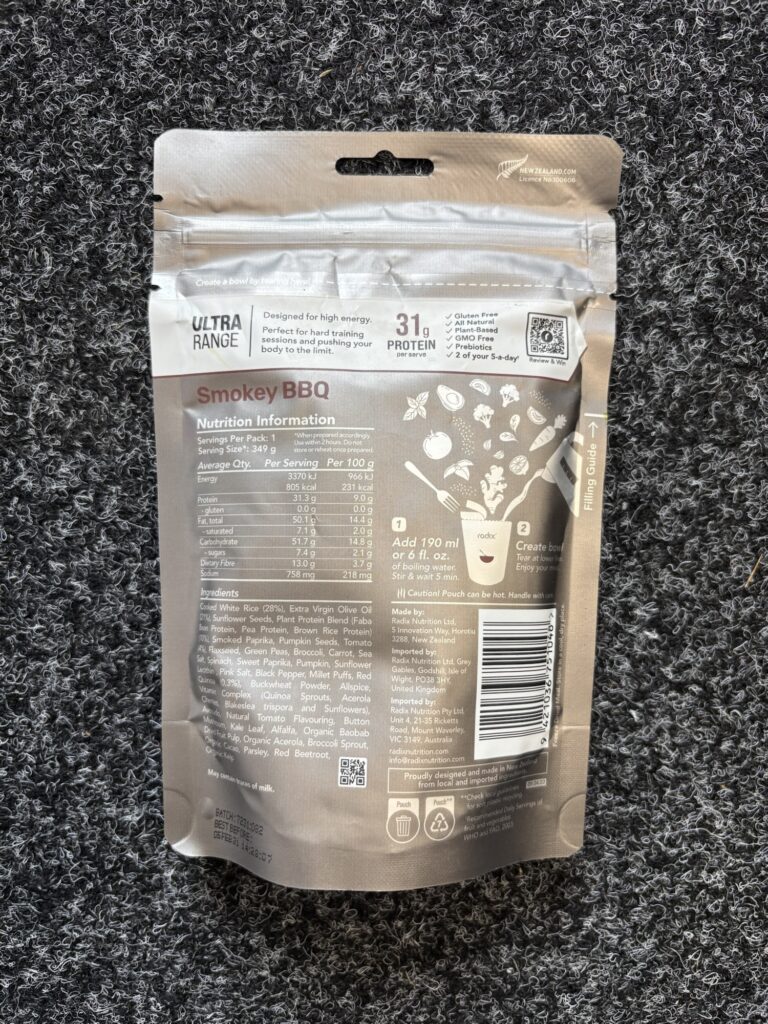
Its ingredient list includes cooked white rice, extra virgin olive oil, sunflower seeds, fava bean protein, pea protein, brown rice protein, pumpkin seeds, flaxseed, peas, broccoli, carrot, quinoa, buckwheat, millet, avocado, mushroom, kale, seaweed, cacao, beetroot, fruit powders, and various herbs and spices.
On paper, it looks more like a deliberately engineered backcountry meal than a traditional freeze-dried dinner.
The most obvious difference is fat.
At around 50 grams of fat, the Radix gets a huge amount of its energy from fat. Using the standard rough estimate of 9 calories per gram of fat, that is about 450 calories from fat alone. That explains how it reaches 800 calories while only weighing 159 grams dry.
This is where the “bioavailability” discussion gets tricky.
Fat is highly energy-dense and generally well absorbed. So it is not true to say the body cannot access those calories. But high-fat meals can digest more slowly, especially when combined with fibre and protein. That matters if you are trying to eat and then immediately keep moving.
The Radix also contains 13 grams of fibre, which is a lot in a single backcountry meal. Fibre is not bad. In normal life, it is usually a good thing. It likely contributes to the meal feeling more substantial and nutritionally complete.
But in the backcountry, context matters.
High fibre can slow digestion. It can increase gut bulk. Some people will tolerate that well. Others may not, particularly when dehydrated, cold, stressed, or working hard.
The plant protein blend is also worth discussing. Plant proteins can be useful, but they are not always as digestible or amino-acid-complete as animal proteins unless blended or processed carefully. In this case, fava bean, pea, and brown rice protein likely improve the amino acid profile compared with relying on one plant source alone.
The Radix meal is probably more nutrient-dense, more calorie-dense, and more complete in terms of fats, fibre, plant compounds, and ingredient diversity.
But that does not make it automatically better for every hunter in every context.
It is a richer meal. Some people will handle that well. Others may find that 50 grams of fat and 13 grams of fibre is a bit much after a long day under load.
The Water Problem
There is another practical point here: water.
Back Country Cuisine Roast Chicken requires 500 ml of boiling water.
Radix Smokey BBQ requires 250 ml.
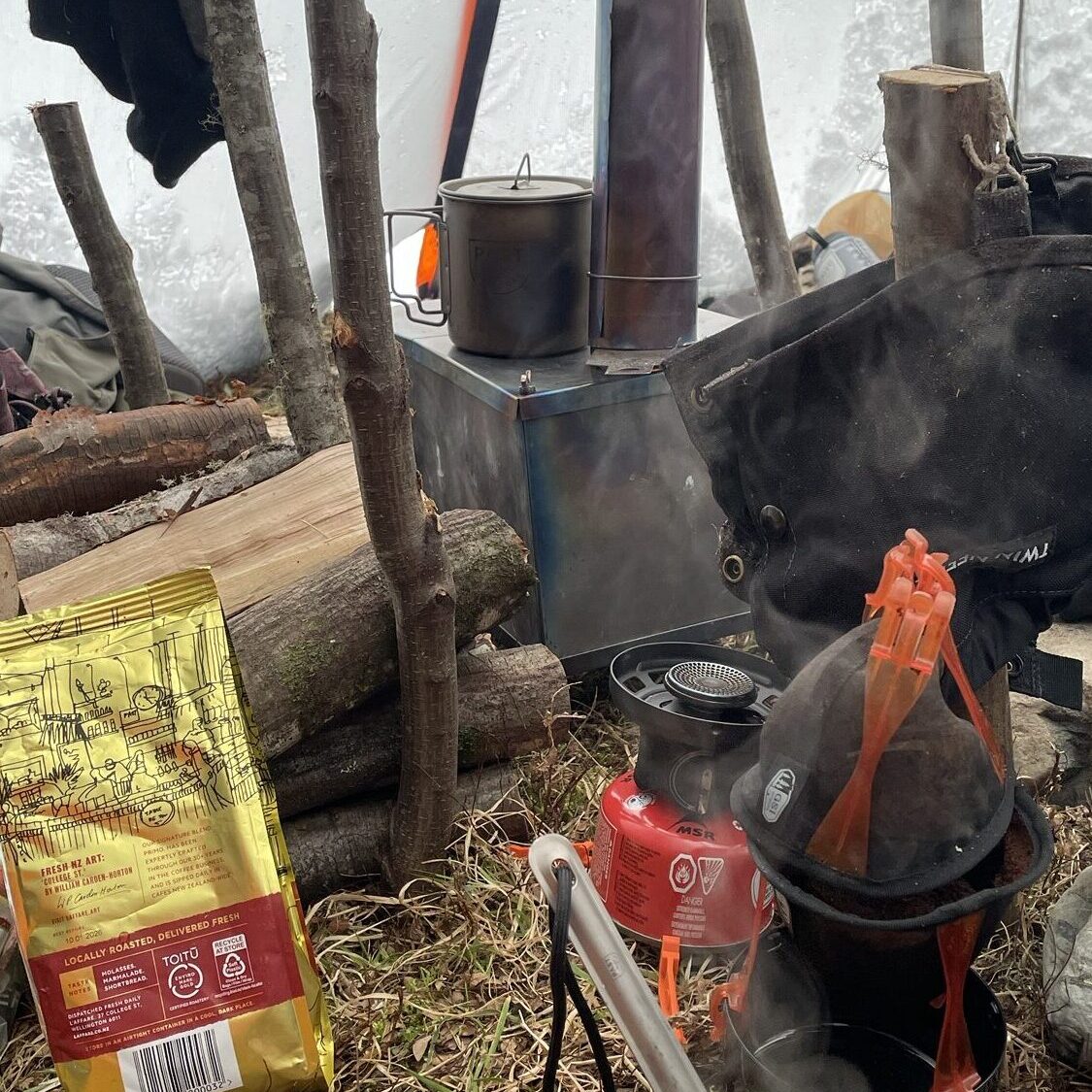
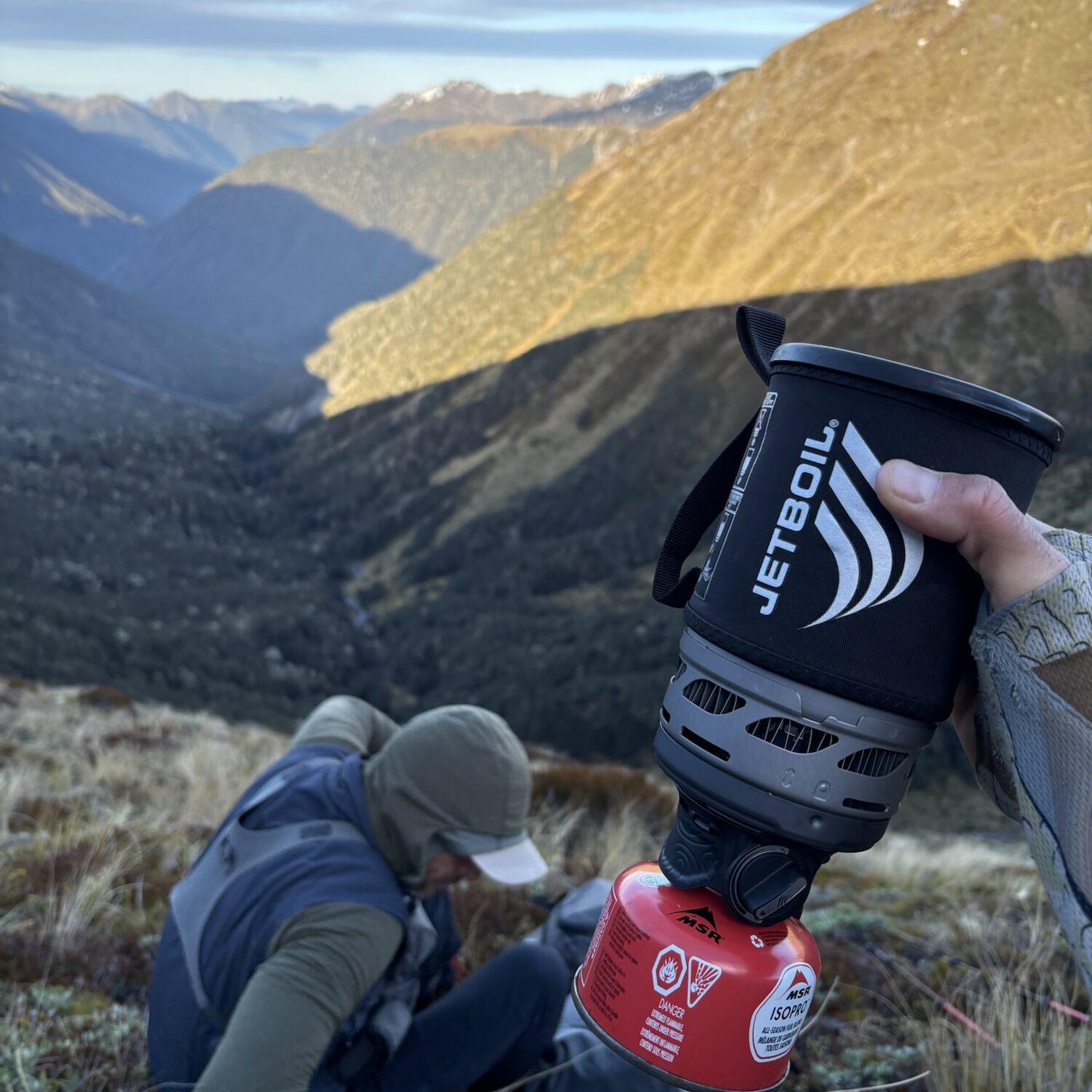
If water is abundant, that may not matter much. If water is scarce, frozen, silty, tannin-stained, or requires a climb or descent to access, it matters a lot. It also affects fuel use. Heating 500 ml instead of 250 ml is not a big deal once, but over several meals it adds up.
Prepared weight also changes the energy density of the food you are actually eating.
Back Country Cuisine Roast Chicken ends up at around 675 grams prepared. That gives roughly 761 calories across 675 grams of food.
Radix ends up closer to 409 grams prepared if you add 250 ml of water to the 159 gram meal. That gives roughly 800 calories across 409 grams of food.
That does not mean you are carrying all that water if you source it on the hill. But it does affect stomach volume, cooking logistics, fuel demand, and how much water you need available at camp.
A meal is not just dry weight.
It is also water, time, fuel, appetite, and gut tolerance.
The 24-Hour Carry-Out: Eating “Enough” and Still Being Deep in the Hole
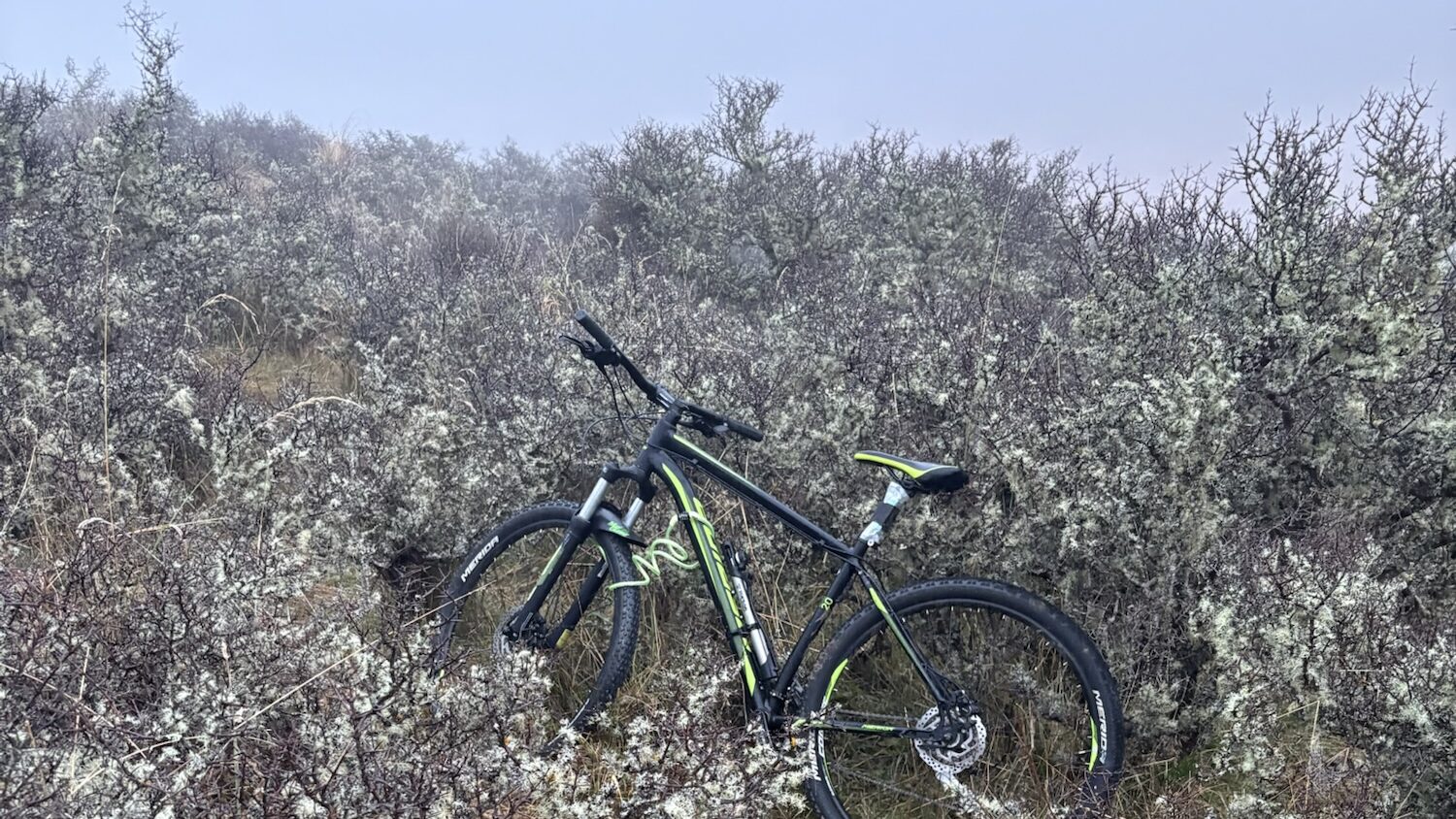
On a recent overnight trip, I completed the following movement in roughly a 24-hour period:
- Mountain bike: 3.63 miles / 5.84 km
- Walk: 3.11 miles / 5.00 km
- Walk: 3.23 miles / 5.20 km
- Mountain bike: 3.71 miles / 5.97 km
Total distance was around 13.68 miles, or 22.01 km.
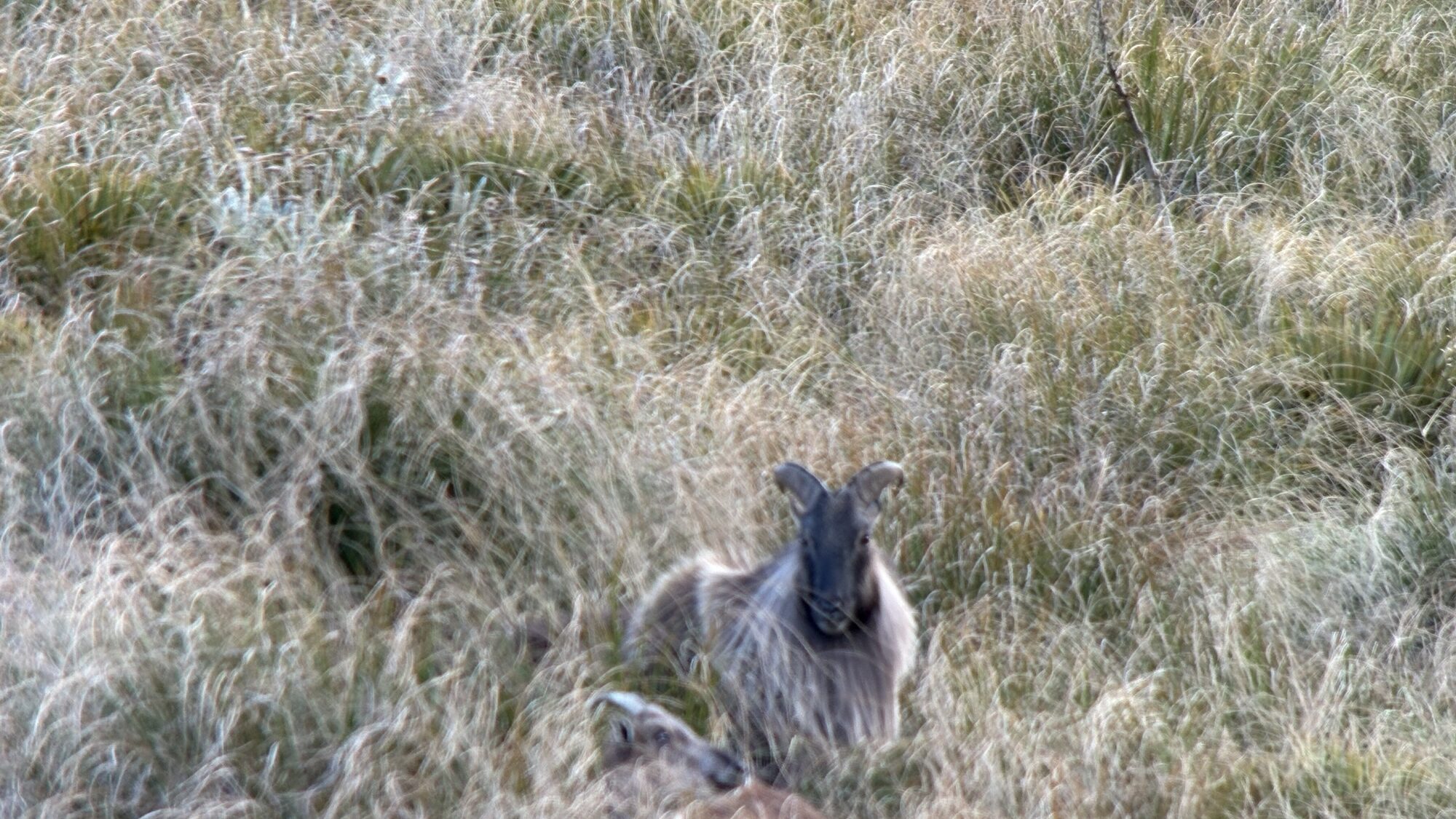
For the first two activities, my pack weight was approximately 23 kg. For the last two, my pack weight was closer to 48 kg, with a tahr head, a full pack of meat, and a tahr cape.
According to Garmin, my active calorie output was around 1300 calories per day for two days, or roughly 2600 active calories total.
My total calories, including active and resting expenditure, were closer to:
- Day one: approximately 4800 calories
- Day two: approximately 3600 calories
That gives a two-day total of around 8400 calories.
During that period, I ate:
- One Radix Smokey BBQ meal
- Two Bumper protein bars
- Two Nice & Natural protein bars
Depending on the exact bar flavours, that is roughly:
- Radix: 800 calories
- Two Bumper bars: around 740 to 750 calories
- Two Nice & Natural protein bars: around 330 to 350 calories
Total intake was likely around 1870 to 1900 calories.
Against Garmin’s active calories alone, that does not look too bad. But active calories are not the full picture. You still have to account for resting metabolic needs, thermoregulation, recovery, digestion, and simply existing for two days in the mountains.
Using Garmin’s total calorie estimate:
8400 calories expended minus approximately 1900 calories eaten leaves a deficit of about 6500 calories.
That is a massive hole.
Even if Garmin overestimated the total by a meaningful margin, I was still in a serious deficit.
That experience is probably familiar to most hunters. You can eat what feels like a reasonable amount of food on a hard trip and still be wildly under-fuelled. The body will tolerate that for a short period, especially if you have reserves. But it has consequences: lower mood, poorer decision-making, reduced warmth, slower recovery, and a much harder time backing up for another hard day.
This is where the article becomes less theoretical.
The question is not just, “How many calories did I pack?”
It is, “Did I pack enough food that I could actually eat, digest, and use?”
Jerky, Biltong, Salami, and Cheese
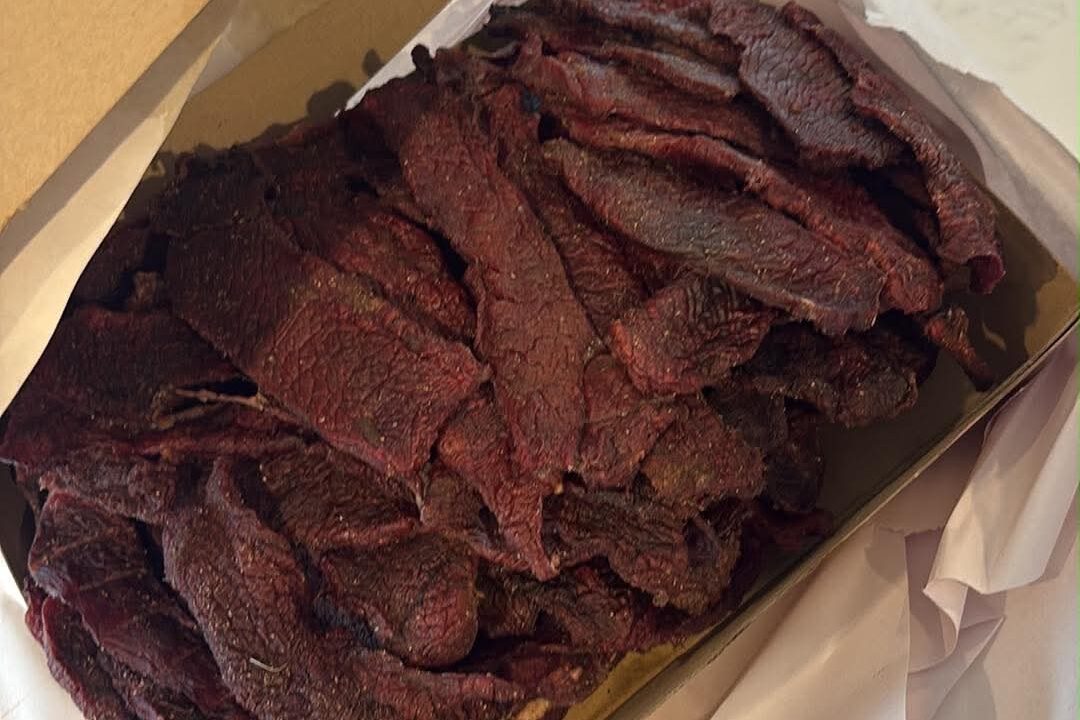
Jerky is a hunting favourite for good reason.
It is durable, savoury, salty, protein-rich, and culturally perfect. It feels like it belongs in a hunting pack. It is also easy to eat while glassing, easy to share, and does not require cooking.
But standard lean jerky is not usually a calorie-density monster.
A lot of jerky and biltong is high in protein, low in fat, and fairly low in carbohydrate. That makes it excellent for satiety and muscle repair, but not necessarily a high-calorie fuel source.
This is where fatty biltong is different.
The Original Beef Chief Fatty Biltong product is more interesting than standard lean jerky because the fat content lifts its energy density. It starts to move toward the same general category as salami and hard cheese: savoury, salty, protein-containing, and more calorie-dense because of fat.
That matters because fat is what usually turns a protein food into a true backcountry energy food.
Lean jerky is mostly protein.
Fatty biltong is protein plus fat.
Salami is protein plus a lot of fat.
Hard cheese is protein plus a lot of fat.
That is why salami and hard cheese have such a strong reputation as backcountry foods. They are dense, savoury, satisfying, and do not require cooking. Their fat content makes them much more energy-dense than lean meat snacks.
The practical distinction is simple:
Lean jerky is not really a calorie food. It is a protein, salt, and morale food. Fatty biltong moves closer to being a genuine energy food because the fat content lifts it toward the 100-calorie-per-ounce threshold.
It is probably not a replacement for dinner. But it is an excellent bridge food.
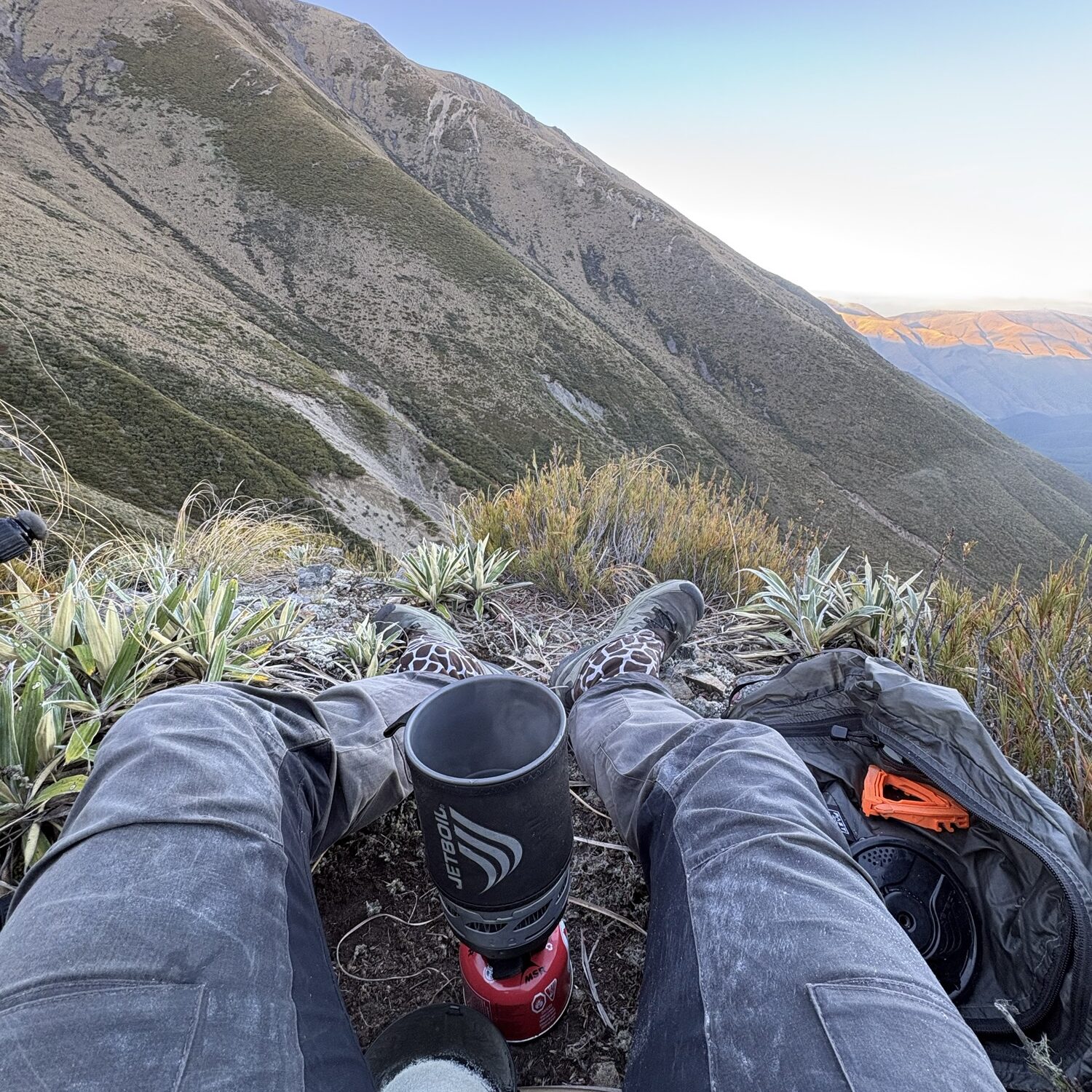
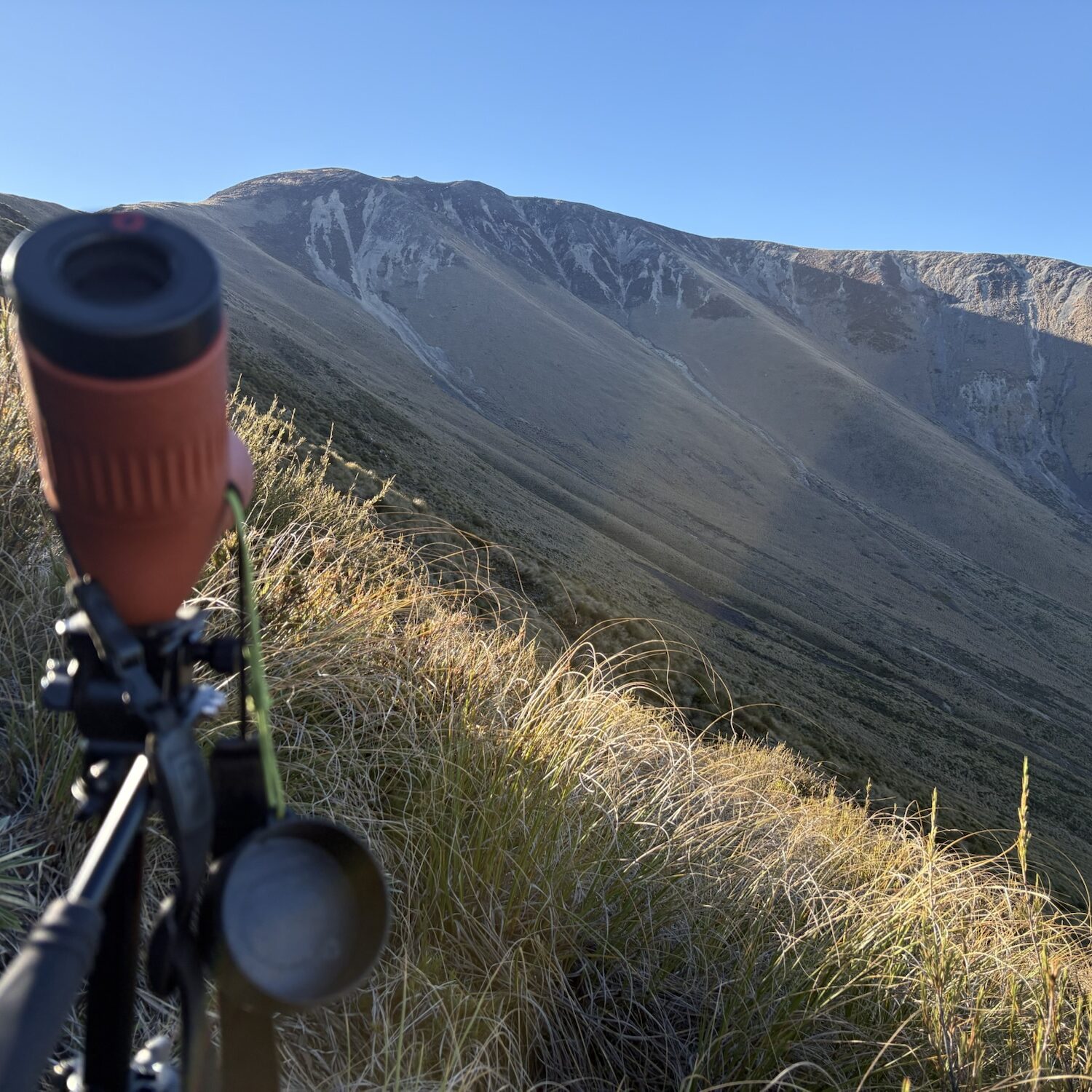
Something to eat while glassing.
Something savoury when you are sick of sugar.
Something with protein when your food bag is otherwise dominated by bars and carbohydrates.
Something that feels like hunting food, not just endurance food.
And that matters.
Oreos and the Morale Calorie
Oreos are not sports nutrition.
They are biscuits. They are sugar, refined carbohydrate, vegetable oil, and joy.
But that does not mean they are useless.
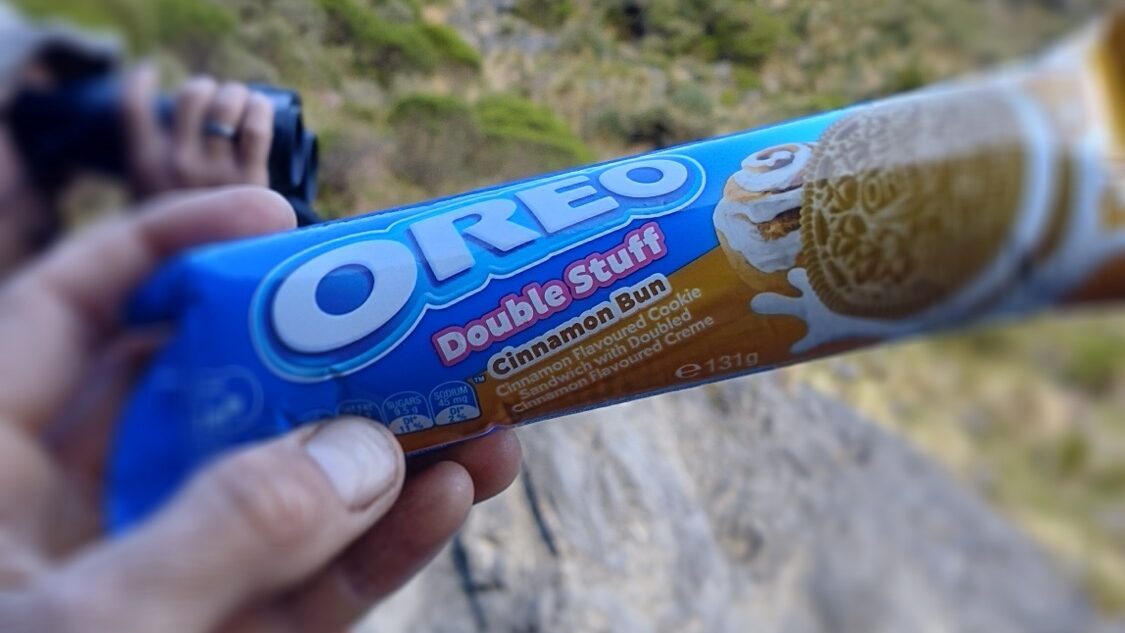
In fact, Double Stuf Oreos are surprisingly efficient by weight. They are often around 480 to 500 calories per 100 grams, depending on the exact product and serving size. That puts them at roughly 135 to 142 calories per ounce.
That is better than a lot of purpose-built endurance products.
Compare that with Clif Bloks. Clif Bloks are designed as quick carbohydrate during exercise. They are usually around 90 to 100 calories per 30 gram serving, mostly from carbohydrate, with little or no fat, fibre, or protein.
By weight, Oreos are more calorie-dense than Clif Bloks.
But that does not mean Oreos are better performance fuel.
They are different tools.
Clif Bloks are a performance product. They are basically controlled carbohydrate delivery. They are easy to portion, easy to chew, easy to use while moving, and some versions include caffeine or electrolytes. They are designed for runners, cyclists, and endurance athletes who need quick carbohydrate without much digestive complexity.
Oreos are a morale food that happens to be calorie-dense. The fat makes them more energy-dense, but it may also slow digestion compared with a pure carbohydrate chew. That is not necessarily bad. It just means they are not the same thing.
For a hard climb, race-paced push, or the last hour before dark, Clif Bloks make sense.
For glassing, camp, a cold morning, or a psychological lift when you are sick of protein bars, Oreos absolutely have a place.
The conclusion is not that Oreos are better than Clif Bloks.
The conclusion is this:
Clif Bloks are a performance tool. Oreos are a calorie-dense morale food that happen to be surprisingly efficient by weight.
And morale food matters.
That may sound soft, but it is not. Food you will actually eat when cold, tired, and flat is more useful than perfect food you avoid because you are sick of it.
Supermarket Food Versus Backpacking Food
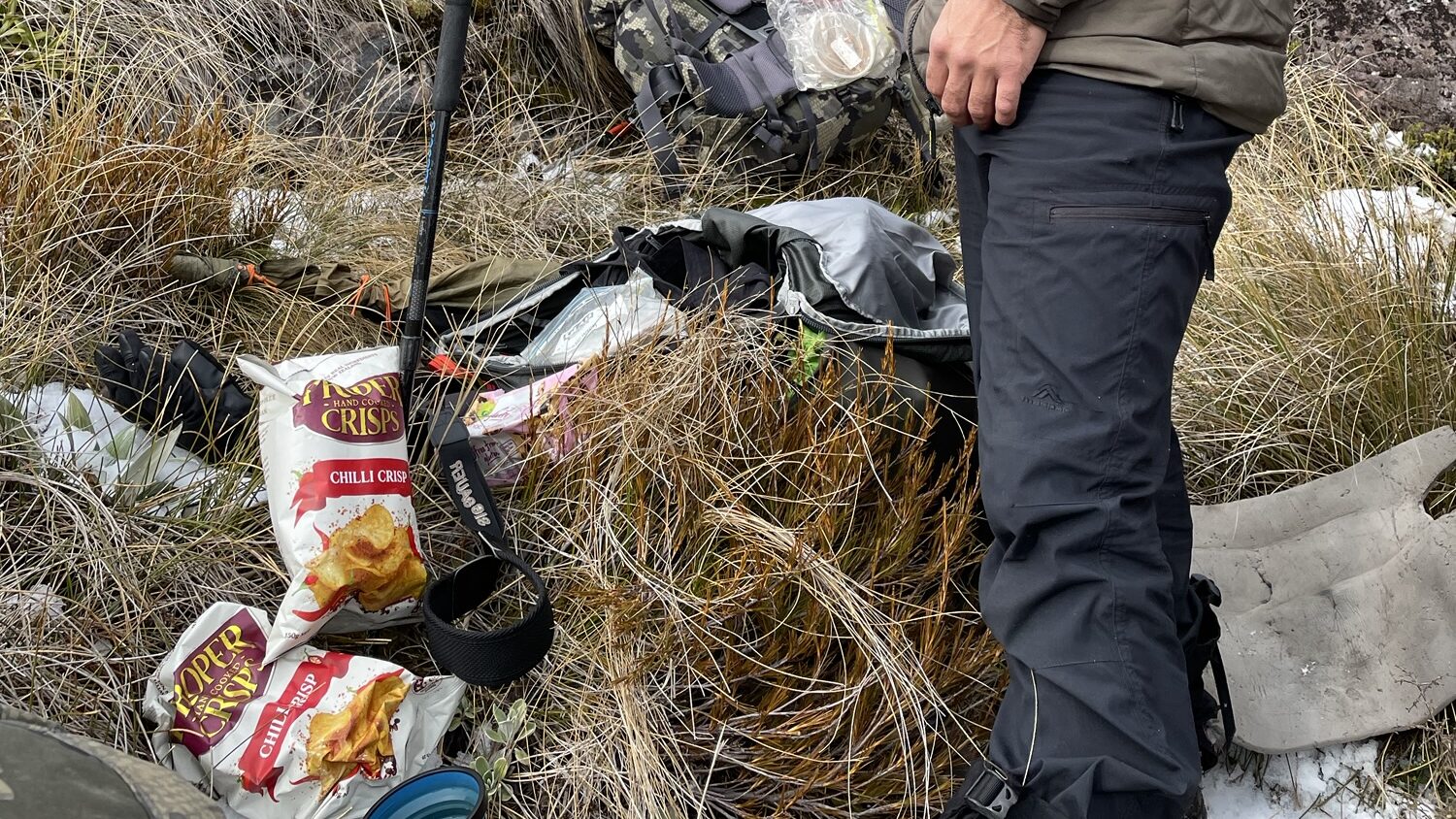
This is where the Wyoming hunter’s food plan becomes useful.
Raisins, dates, bars, and corn chips are not sophisticated. But they are light enough, calorie-dense enough, easy to eat, and require no cooking. For someone with a strong endurance background, that may work extremely well.
Purpose-built backpacking meals have advantages:
- They are convenient.
- They are portioned.
- They are shelf-stable.
- They are usually easy to pack.
- They provide a hot meal.
- They often provide a better macro balance than random snacks.
- They reduce planning complexity.
But they also have disadvantages:
- They are expensive.
- They require water.
- They require fuel.
- They require time.
- Some are bulky once prepared.
- Some are not as nutrient-dense as the marketing suggests.
- Some people simply do not feel good eating them.
Supermarket food has the opposite profile.
It can be cheap, accessible, calorie-dense, and easy to eat without cooking. But it requires more thought. If you build a food bag from biscuits, corn chips, bars, raisins, and dates, you may get plenty of carbohydrate and calories, but you may miss protein, salt balance, fat variety, and actual meal satisfaction.
The smart answer is probably not choosing one side.
It is building a system.
A Radix or Back Country meal for dinner.
Biltong, salami, or cheese for savoury protein and fat.
Oreos or chocolate for morale calories.
Dates, raisins, or chews for fast carbohydrate.
Corn chips for salt, crunch, and calories.
Bars for convenience.
Electrolytes when water intake and sweat loss demand it.
That is a better approach than blindly trusting either the freeze-dried aisle or the supermarket snack aisle.
What “Bioavailability” Really Means Here
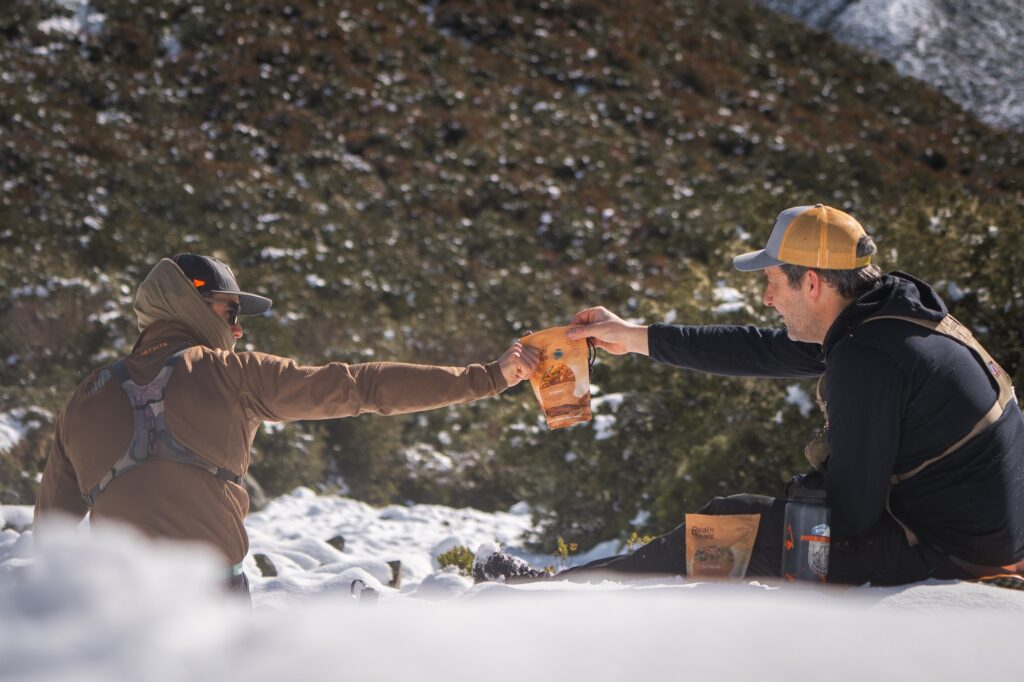
Strictly speaking, bioavailability refers to how much of a nutrient is absorbed and becomes available to the body.
But in the backcountry, I think people often use the word more loosely. They are really talking about practical availability.
That includes:
- Can I eat it?
- Can I digest it?
- Can I absorb it?
- Can I use it during the type of work I am doing?
- Will it make me feel better or worse?
- Does it require water?
- Does it require cooking?
- Does it still appeal to me on day four?
- Does it help me stay warm, alert, and functional?
That is the version of bioavailability that matters to hunters.
Not laboratory perfection.
Practical usefulness.
For example, fat is highly energy-dense and generally well absorbed. But a very high-fat meal may not be the best choice immediately before hard uphill movement.
Fast carbohydrate is useful during exertion. But a diet made only of sugar and dried fruit may become monotonous, gut-heavy, and protein-poor.
Protein is important for satiety and recovery. But protein is not the body’s preferred quick fuel during hard movement.
Fibre is good in normal nutrition. But too much fibre at the wrong time can be a problem under load.
Salt can be excessive in normal life. But after sweating under a pack, salt can be exactly what you crave.
The mountain changes the context.
The Practical Framework
For future trips, I would not judge food by calories per ounce alone.
I would start there, but then ask a better set of questions.
1. What job does this food do?
Is it a dinner, a moving snack, a glassing snack, a recovery food, a morale food, or emergency food?
A Radix meal and a packet of Clif Bloks are both useful, but they do completely different jobs.
2. Can I eat it when I am tired?
This is one of the most important questions.
Some food looks good at home and becomes repulsive after two hard days. Other food looks childish or nutritionally crude, but disappears quickly when morale is low.
The food you eat is more useful than the food you merely carry.
3. Does it require water?
This matters more than people think.
A meal that needs 500 ml of boiling water is different from a meal that needs 250 ml. A no-cook food is different again.
Water availability can decide whether a food plan works.
4. Does it require fuel and time?
A stove is not just stove weight. It is fuel, lighter, pot, time, and faff.
But no stove also has a cost. No hot drinks. No hot meal. No warm psychological reset at the end of the day.
On a short summer hunt, that may not matter. On a cold five-day tahr hunt, it might.
5. What is the macro balance across the whole day?
A day made entirely of bars and dried fruit may have calories, but not enough protein or savoury fat.
A day made entirely of salami, cheese, and nuts may be calorie-dense, but not ideal for hard climbing.
A good backcountry food plan probably needs all three:
- carbohydrate for work
- fat for energy density
- protein for satiety and recovery
6. What does it do for morale?
This is not a joke.
A hot meal, a coffee, a biscuit, a piece of salami, or something sweet at the right time can change your mood and decision-making. In hard country, that matters.
The Bottom Line
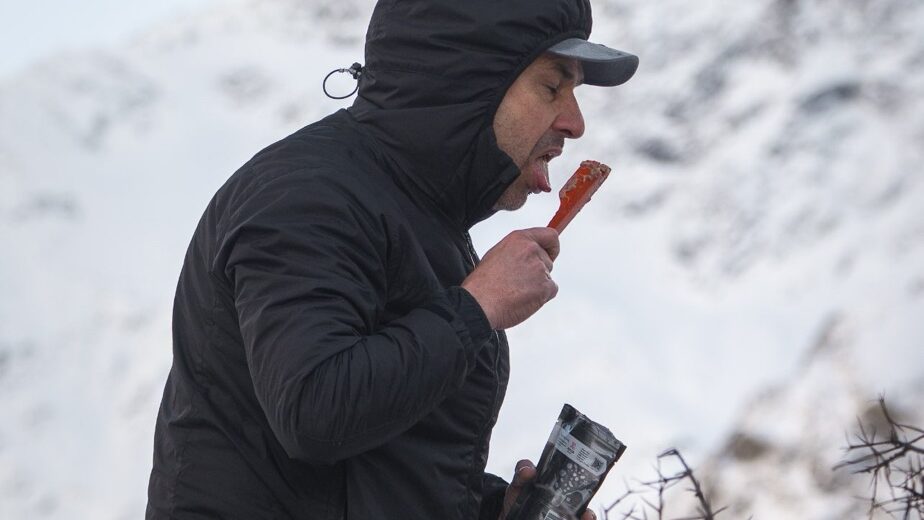
The Back Country Cuisine Roast Chicken meal is not junk because it uses potato flakes, starches, maltodextrin, thickeners, and processed components. In many ways, that makes it a practical backcountry meal: hot, salty, carbohydrate-heavy, familiar, and probably easy to digest.
The Radix Smokey BBQ is not automatically superior because it has a cleaner-looking ingredient list and more calorie density. It is more energy-dense, requires less water, and appears to offer a broader nutritional profile. But it also brings more fat and more fibre, which may or may not suit everyone under exertion.
Fatty biltong is more useful than lean jerky if the goal is energy density, because fat lifts it toward being a genuine calorie food rather than just a protein snack.
Oreos are not performance nutrition, but they are calorie-dense, easy to pack, and valuable for morale.
Clif Bloks are not impressive on calories per ounce compared with fatty snack foods, but they are purpose-built for rapid carbohydrate delivery during hard movement.
And the Wyoming hunter’s no-stove food plan is a useful reminder that purpose-built backpacking meals are not mandatory. They are tools. Good tools, but tools nonetheless.
The mistake is pretending this can all be reduced to one number.
Calories per ounce gets food into the pack.
Bioavailability, digestion, tolerance, water requirement, and morale decide whether it actually works in the mountains.